Code_Aster Study Mirror
Daniel Weschke
October 13, 2018
List of Symbols
\(c\ti{p}\) |
J/(t °C) |
Specific heat capacity at constant pressure |
\(E\) |
MPa |
Young’s modulus |
\(H\) |
MPa |
Elasticity matrix |
\(h\) |
W/(mm² °C) |
Heat transfer coefficient |
\(L\) |
mm |
Length |
\(m\) |
kg |
Mass |
\(\dot{m}\) |
kg/s |
Mass flow rate |
\(\dot{Q}\) |
W |
Heat |
\(\dot{q}\) |
W/mm² |
Heat flux density |
\(r\) |
mm |
Radius |
\(T\) |
°C |
Temperature |
\(t\) |
s |
Time |
\(u\) |
mm |
Displacement |
\(v\) |
mm/s |
Velocity |
\(x\) |
mm |
Beam direction, flow direction |
\(\alpha\) |
1/°C |
Isotropic secant coefficient of thermal expansion |
\(\lambda\) |
W/(mm °C) |
Thermal conductivity |
\(\nu\) |
Poisson’s ratio |
|
\(\rho\) |
t/mm³ |
Density |
1 Objective
Deflection of a silicon mirror subjected to an incident beam with a maximum
bending radius of \(\units[100]{km}\) parallel to the beam.
2 Geometry & Mesh
2.1 Mirror
Width \(\units[60]{mm}\)
Height \(\units[60]{mm}\)
Length \(\units[550]{mm}\)
Material: Silicon
Groove for stabilization
Position: At both sides, \(\units[9]{mm}\) below the top surface, that is below the cooling line
Width or depth \(\units[3.5]{mm}\)
Height \(\units[8]{mm}\)
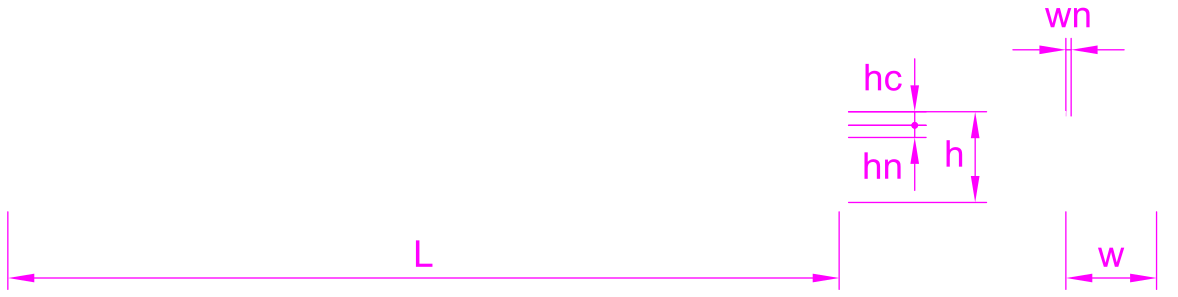
Geometry of the mirror.
2.2 Cooling line
Width \(\units[9]{mm}\)
Height \(\units[9]{mm}\)
Length \(\units[549]{mm}\)
Material: Copper
Position: At both sides at the same level as the top surface of the mirror and one millimetre behind the front face
Drill for water line
Material: Water
Cross-section: Circle with radius \(r\ti{w} = \units[2]{mm}\)
Length \(L\ti{w} = \units[549]{mm}\)
Position: At the centre

2.3 Mesh
Global element size \(\units[3]{mm}\)
Element size at the top surface along the beam \(\units[1]{mm}\)
3 Material
3.1 Water
\(T\) |
\(\rho\ti{w}\) |
\(c\ti{p,Si}\) |
\(\lambda\ti{w}\) |
\(\alpha\ti{w}\) |
|---|---|---|---|---|
°C |
t/mm³ |
J/(t °C) |
W/(mm °C) |
1/°C |
0 |
1.0e-9 |
4219e3 |
5.611e-4 |
-6.77e-5 |
4 |
6.0e-7 |
|||
10 |
8.81e-5 |
|||
20 |
2.066e-4 |
|||
25 |
9.9724e-10 |
4182e3 |
6.072e-4 |
|
30 |
3.029e-4 |
|||
40 |
3.849e-4 |
|||
50 |
9.882e-10 |
4180e3 |
6.436e-4 |
4.574e-4 |
60 |
5.231e-4 |
|||
70 |
5.841e-4 |
|||
75 |
9.7504e-10 |
4192e3 |
6.668e-4 |
|
80 |
6.417e-4 |
|||
90 |
6.97e-4 |
|||
99.61 |
7.489e-4 |
|||
100 |
9.5858e-10 |
2074e3 |
2.508e-5 |
|
150 |
9.1707e-10 |
1986e3 |
2.886e-5 |
Zero-thermal-strain reference temperature for isotropic secant coefficient of thermal expansion is 24 °C.
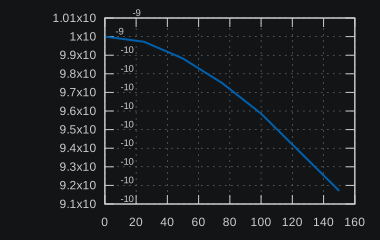
Density \(\rho\ti{w}(T)\)
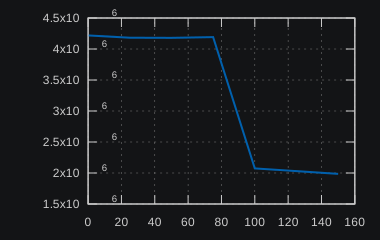
Specific heat capacity at constant pressure \(c\ti{p,w}(T)\)
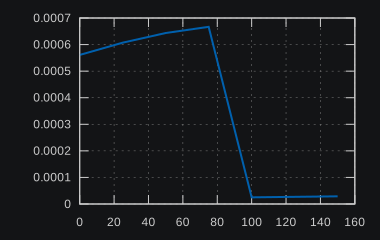
Thermal conductivity \(\lambda\ti{w}(T)\)
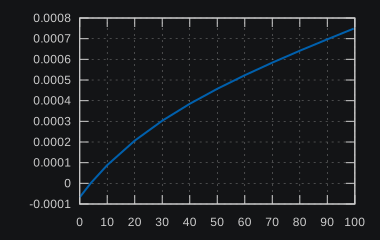
Isotropic secant coefficient of thermal expansion \(\alpha\ti{w}(T)\) with zero-thermal-strain reference temperature at 24 °C
3.2 Silicon
Physical properties
Density \(\rho\ti{Si} = \units[2.3296\times10^{-9}]{t/mm^3}\)
\(T\) |
\(c\ti{p,Si}\) |
\(\lambda\ti{Si}\) |
\(\alpha\ti{Si}\) |
|---|---|---|---|
°C |
J/(t °C) |
W/(mm °C) |
1/°C |
-253.15 |
-5.0e-9 |
||
-243.15 |
-5.3e-8 |
||
-233.15 |
-1.6e-7 |
||
-223.15 |
78.5e3 |
2.600 |
-2.8e-7 |
-213.15 |
115.0e3 |
2.100 |
-3.65e-7 |
-203.15 |
152.0e3 |
1.700 |
-4.15e-7 |
-193.15 |
188.0e3 |
1.390 |
-4.65e-7 |
-183.15 |
224.0e3 |
1.140 |
|
-173.15 |
259.0e3 |
0.950 |
-3.4e-7 |
-153.15 |
328.0e3 |
-4.0e-8 |
|
-148.15 |
0.600 |
||
-123.15 |
0.420 |
5.25e-7 |
|
-98.15 |
0.325 |
||
-73.15 |
556.0e3 |
0.266 |
1.5e-6 |
-23.15 |
0.195 |
||
0.0 |
680.0e3 |
0.168 |
|
20 |
2.6e-6 |
||
26.85 |
714.0e3 |
0.156 |
|
100.0 |
770.0e3 |
0.108 |
|
126.85 |
0.105 |
||
226.85 |
0.08 |
||
227 |
3.5e-6 |
||
300.0 |
850.0e3 |
||
326.85 |
0.064 |
||
426.85 |
0.052 |
||
500.0 |
880.0e3 |
||
526.85 |
0.043 |
||
626.85 |
0.036 |
||
726.85 |
0.031 |
||
826.85 |
0.028 |
||
926.85 |
0.026 |
||
1026.85 |
0.025 |
||
1126.85 |
0.024 |
||
1226.85 |
0.023 |
||
1326.85 |
0.022 |
||
1407.85 |
0.022 |
Zero-thermal-strain reference temperature for isotropic secant coefficient of thermal expansion is 24 °C
3.2.1 Thermal
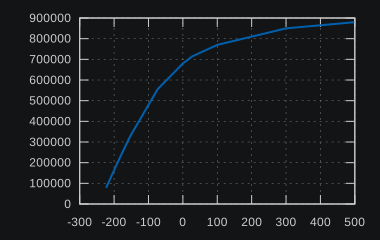
Specific heat capacity at constant pressure \(c\ti{p,Si}(T)\)
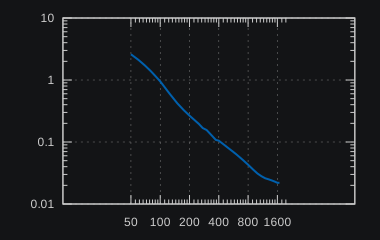
Thermal conductivity \(\lambda\ti{Si}(T)\) in W/(mm K)
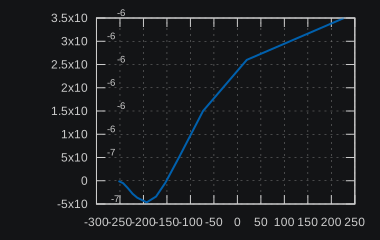
Isotropic secant coefficient of thermal expansion \(\alpha\ti{Si}(T)\) with zero-thermal-strain reference temperature at 24 °C
Volumetric heat capacity \(\rho\ti{Si}\,c\ti{p,Si}\)
3.2.2 Mechanical - Linear elastic
Anisotropic Elasticity [1]
Derivative properties in principle directions:
Young’s modulus \(E\ti{Si} = (H\ti{Si}^{-1})_{11}^{-1} = (H\ti{Si}^{-1})_{22}^{-1} = (H\ti{Si}^{-1})_{33}^{-1} \approx \units[130.3826]{MPa}\)
Shear modulus \(G\ti{Si} = (H\ti{Si}^{-1})_{44}^{-1} = (H\ti{Si}^{-1})_{55}^{-1} = (H\ti{Si}^{-1})_{66}^{-1} = \units[80]{MPa}\)
Poisson’s ratio \(\nu\ti{Si} = -(H\ti{Si}^{-1})_{12}/(H\ti{Si}^{-1})_{11} = -(H\ti{Si}^{-1})_{23}/(H\ti{Si}^{-1})_{22} = -(H\ti{Si}^{-1})_{31}/(H\ti{Si}^{-1})_{33} \approx {0.2782609}\)
3.3 Copper
Physical properties
Density \(\rho\ti{Cu} = \units[8.960\times10^{-9}]{t/mm^3}\)
Isotropic secant coefficient of thermal expansion \(\alpha\ti{Cu} = \units[1.7\times10^{-5}]{1/\degC}\)
3.3.1 Thermal
\(T\) |
\(c\ti{p,Cu}\) |
\(\lambda\ti{Cu}\) |
|---|---|---|
°C |
J/(t °C) |
W/(mm °C) |
-100.0 |
0.420 |
|
-73.15 |
356.1e3 |
|
-23.15 |
374.1e3 |
|
-23.0 |
0.406 |
|
0.0 |
0.403 |
|
25.0 |
385.0e3 |
|
27.0 |
0.4005 |
|
76.85 |
392.6e3 |
|
77.0 |
0.396 |
|
100.0 |
0.3945 |
|
126.85 |
398.6e3 |
|
127.0 |
0.393 |
|
300.0 |
0.381 |
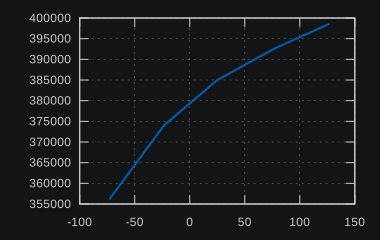
Specific heat capacity at constant pressure \(c\ti{p,Cu}(T)\)
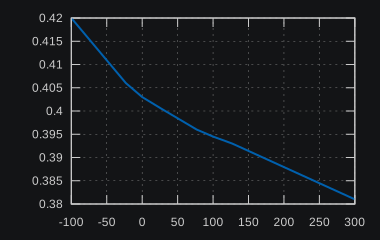
Isotropic thermal conductivity \(\lambda\ti{Cu}(T)\)
Volumetric heat capacity \(\rho\ti{Cu}\,c\ti{p,Cu}\)
4 Boundary Conditions and Loads
4.1 Thermal
Heat flux density \(\dot{q}(x, y)\) on top surface:
beamxy_f
import numpy as np
from scipy.interpolate import RectBivariateSpline

file = "beamprofile.out" # all x values for one y and so forth
nx = 936                 # number of points in x direction
ny = 1000                # number of points in y direction
                         # = total # of lines / # of points in x direction
with open(file, "r") as f:
  lines = f.readlines()
  x, y = np.zeros((nx)), np.zeros((ny))
  z = np.zeros((nx, ny))
  j, k = 0, -1
  for i, line in enumerate(lines):
    line_split = line.split(' ')
    j = i%nx
    if i < nx:
      x[j] = float(line_split[0])
    if j == 0:
      k += 1
      y[k] = float(line_split[1])
    z[j][k] = float(line_split[2][:-1])

interp_spline = RectBivariateSpline(x, y, z)
x1, x2, y1, y2 = 0.0, 550.0, 26.0, 34.0
beamxy_f = lambda X, Y: float(interp_spline.ev(X, Y)) if Y >= y1 and Y <= y2 else 0.0
heat_total = interp_spline.integral(x1, x2, y1, y2)
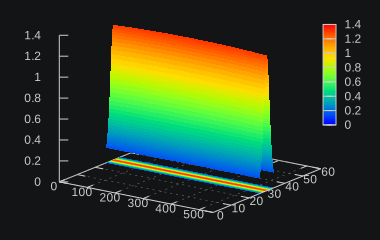
Heat flux density of the beam \(\dot{q}(x,y)\) at the top face.
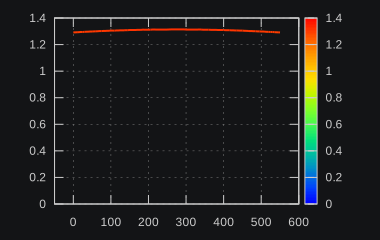
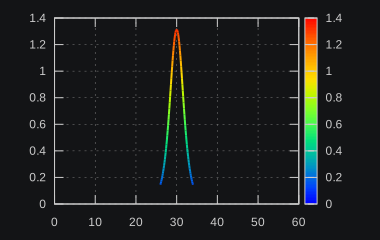
Heat flux density of the beam \(\dot{q}(30,y)\) along the top face.
Heat flux density of the beam \(\dot{q}(x,275)\) along the top face.
Heat transfer between water (external) and copper
External temperature \(T\ti{w}(x) = T\ti{0,w} + \Delta T\ti{w} (1 - x/L\ti{w})\)
Mass flow rate \(\dot{m}\ti{w} = \units[8.3333\times10^{-2}]{kg/s}\)
Total heat \(\dot{Q} = \iint \dot{q} dxdy = \units[3014.63736347]{W}\):
heat_totalTemperature change in °C \(\Delta T\ti{w} = \dot{Q} / (2 \, \dot{m}\ti{w} \, c\ti{p,w})\)
Temperature at the beginning of the line \(T\ti{0,w} = \units[20.0]{\degC}\)
Heat transfer coefficient \(h\ti{w} = \units[0.0297]{W/(mm^2.\degC)}\)
Steady-state one-dimensional heat transfer equation
\(x\) flow direction
\(v(r)\) velocity
Introduce a correction function.
The condition of same integral with the correction function.
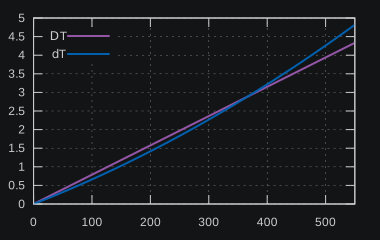
Temperature change profile of the water pipe.
5 Results
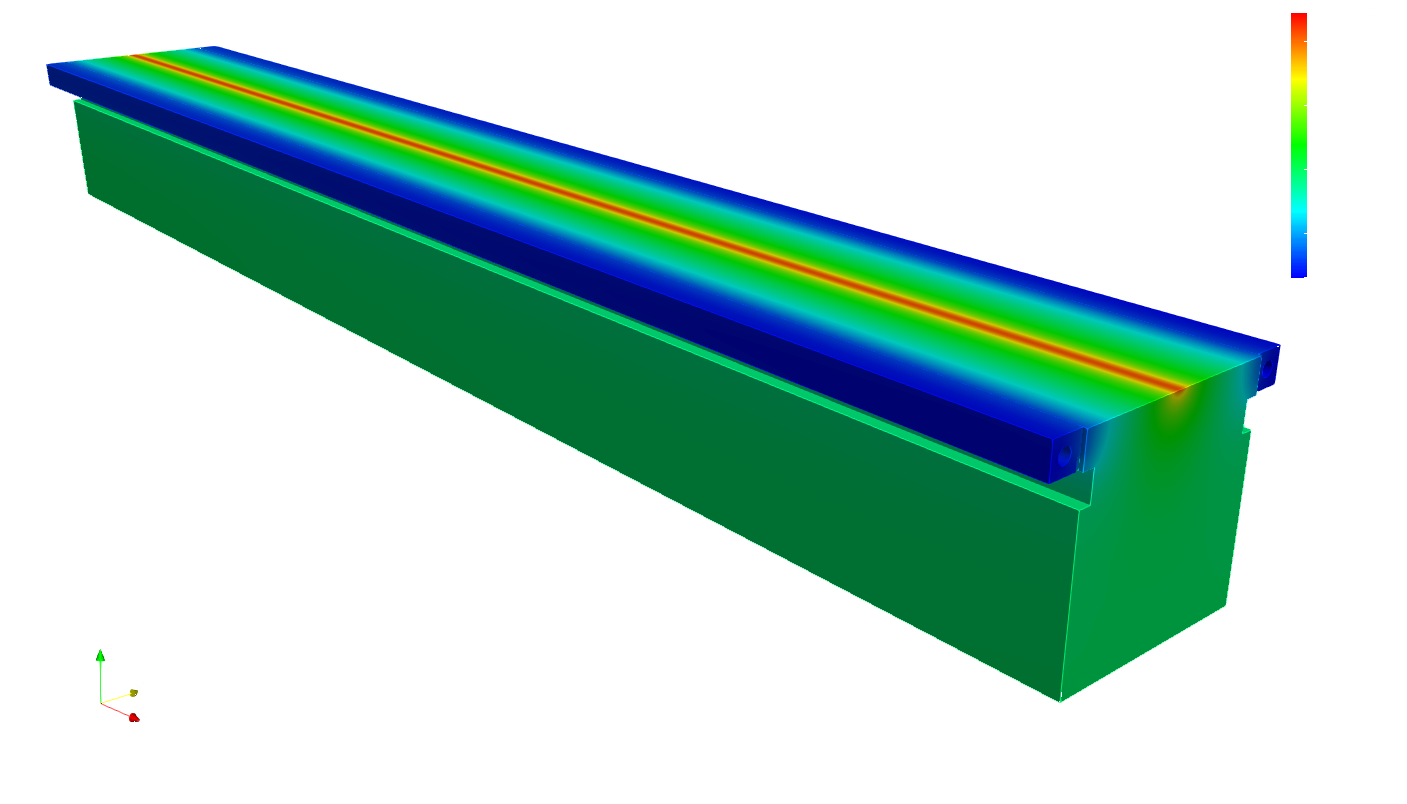
Temperature.
Mesh |
Nodes |
Temperature range |
Temperature range |
|---|---|---|---|
\(\Delta{}T\) in °C |
\(\delta{}T\) in °C |
||
normal |
592341 |
[26.0746, 102.843] |
[26.0375, 36.0593], [32.1906, 103.096] |
fine |
883616 |
[] |
|
finer |
1774863 |
[26.0344, 102.311] |
|
finest |
2877747 |
[26.0347, 102.339] |
|
reference |
[26.126, 103.48] |
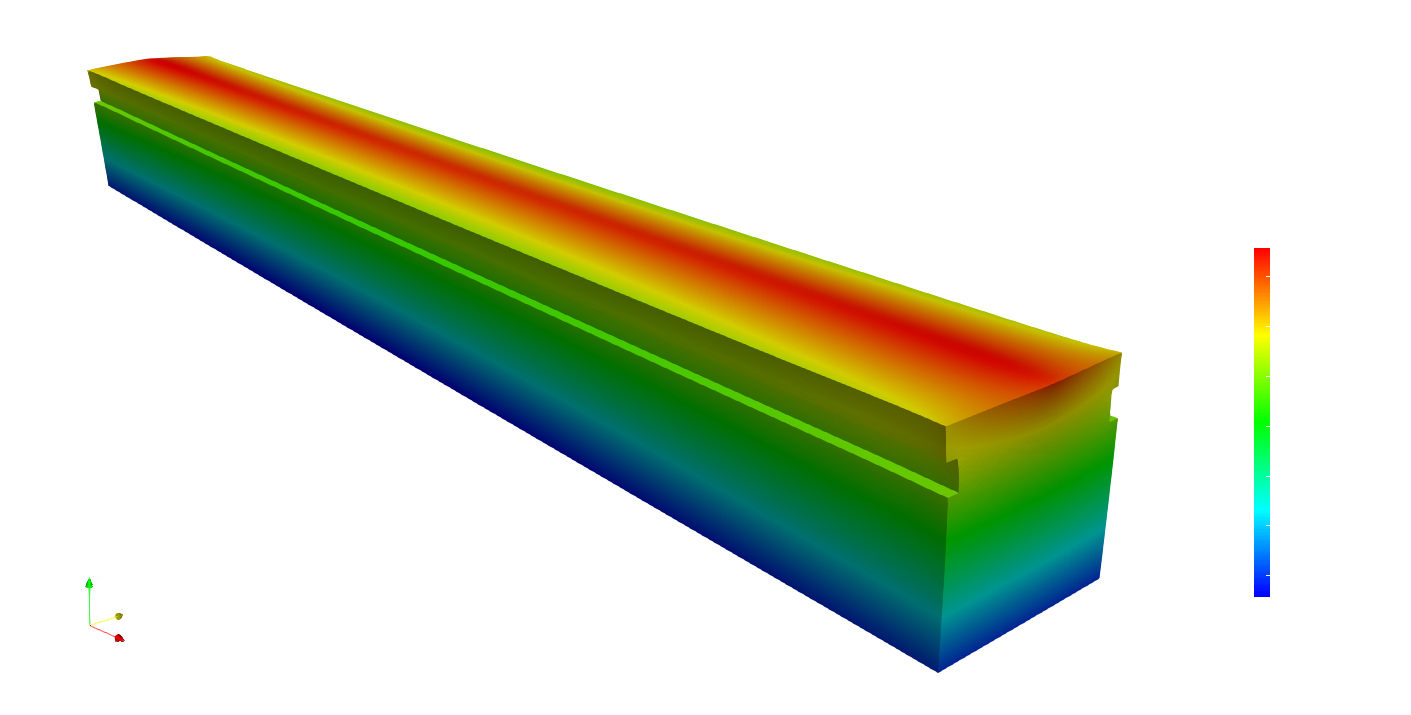
Displacement in z direction.
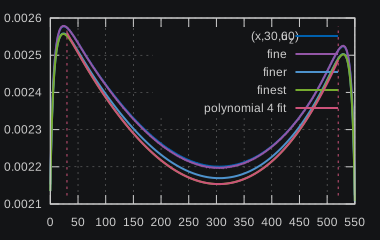
Displacement \(u\ti{z}\) and fit of the displacement in z direction along the top face.
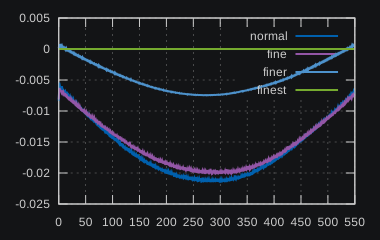
Compared displacement with finer meshes
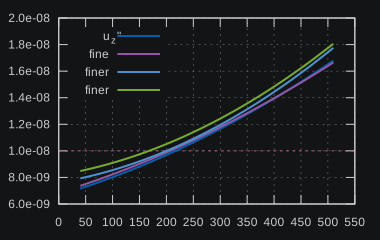
Curvature via polynomial fit of the top face in z direction.
The peak-to-peak value is around 403.46 nm.
The maximum curvature is around 18.4 per pm. Therefore a minimum radius of around 54.4 km.