Bar theory

Daniel Weschke

March 11, 2016

List of Symbols

\(A\)

Cross-section

\(b\ti{x}\)

Acceleration in x direction

\(C\)

Constant of integration

\(E\)

Young’s modulus (elastic)

\(F\)

Force

\(L\)

Length

\(p\ti{x}\)

Distributed normal force in x direction

\(T, T_0, \Delta T\)

Temperature at the point of interest, total temperature, temperature change

\(t\)

Time

\(u\)

Displacement

\(x\)

Location

\(\alpha_\ell\)

Thermal expansion coefficient

\(\varepsilon\ti{xx}, \varepsilon\ti{th,xx}\)

Normal strain in x direction elastic and thermal

\(\rho\)

Density

\(\sigma\ti{xx}\)

Normal stress in x direction

1 Continuous bar model

Assumptions:

  • Uniaxial stress condition

For a bar model with uniaxial stress condition the balance of forces yields

\begin{align} \rho\ddot{u}\dif{x}\dif{y}\dif{z} &= \left( - \sigma\ti{xx} + \sigma\ti{xx} + \frac{\partial \sigma\ti{xx}}{\partial x}\dif{x} \right) \dif{y}\dif{z} + \rho b\ti{x}\dif{x}\dif{y}\dif{z} \nonumber\\ \rho\ddot{u}\dif{x}\dif{y}\dif{z} &= \frac{\partial \sigma\ti{xx}}{\partial x}\dif{x}\dif{y}\dif{z} + \rho b\ti{x}\dif{x}\dif{y}\dif{z} \nonumber\\ \rho\ddot{u} &= \frac{\partial \sigma\ti{xx}}{\partial x} + \rho b\ti{x} \label{eq:diff} \end{align}

The desired displacement and the descriptive variables are only dependent on the location \(x\) as well as the time \(t\): Displacement \(u(x,t)\), density \(\rho(x,t)\), normal stress \(\sigma\ti{xx}(x,t)\) and acceleration \(b\ti{x}(x,t)\).

It follows that, in the case of integration via the transverse directions, the cross-section can be calculated independently. In general, the cross-section also depends on \(x\) and \(t\): \(A(x,t)\).

\begin{align} \rho A \ddot{u} &= \frac{\partial A \sigma\ti{xx}}{\partial x} + \rho A b\ti{x} \nonumber \\ \rho A \ddot{u} &= \frac{\partial A \sigma\ti{xx}}{\partial x} + p\ti{x} \label{eq:diff-A} \end{align}

The second term on the right-hand side can be expressed by the distributed normal force

\[p\ti{x} = \rho A b\ti{x}\]

1.1 Small displacement (linear deformation)

Assumptions:

  • [repeated] Uniaxial stress condition

  • Linear-elastic constitutive relation (material) / Hooke’s law

  • Linear-elastic kinematic quantities

  • Linear thermal deformation

Linear-elastic constitutive relation for one-dimensional stress state.

\[\sigma\ti{xx} = E \varepsilon\ti{me,xx} = E (\varepsilon\ti{xx} - \varepsilon\ti{th,xx})\]

Used in the equation \eqref{eq:diff-A}

\begin{align} \rho A \ddot{u} &= \frac{\partial}{\partial x} EA (\varepsilon\ti{xx} - \varepsilon\ti{th,xx}) + p\ti{x} \label{eq:diff-EAeps} \end{align}

Linear-elastic kinematic relation

\[\varepsilon\ti{xx} = \frac{\partial u}{\partial x}\]

and linear thermal deformation

\[\varepsilon\ti{th,xx} = \alpha_\ell (T - T_0) = \alpha_\ell \Delta T\]

The proportionality factor \(\alpha_\ell\) is referred to as the thermal expansion coefficient.

Both elongations are used in the equation \eqref{eq:diff-EAeps}

\begin{align} \rho A \ddot{u} &= \frac{\partial}{\partial x} EA \left(\frac{\partial u}{\partial x} - \alpha_\ell \Delta T \right) + p\ti{x} \label{eq:diff-EAdudx} \end{align}

With the product rule for derivatives follows

\begin{align} \rho A \ddot{u} &= A \frac{\partial{E}}{\partial x}\frac{\partial u}{\partial x} - A \alpha_\ell \Delta T \frac{\partial{E}}{\partial x} + E \frac{\partial{A}}{\partial x}\frac{\partial u}{\partial x} - E \alpha_\ell \Delta T \frac{\partial{A}}{\partial x} + EA \frac{\partial^2 u}{\partial x^2} - EA \frac{\partial}{\partial x} \alpha_\ell \Delta T + p\ti{x} \label{eq:diff-Eu} \end{align}

1.1.1 Example of constant quantities

Assumptions:

  • [re-repeated] Uniaxial stress condition

  • [repeated] Linear-elastic constitutive relation (material) / Hooke’s law

  • [repeated] Linear-elastic kinematic quantities

  • [repeated] Linear thermal deformation

  • Static load (time invariant)

  • Descriptive quantities \(E,A,p\ti{x},\alpha_\ell,T\) are constant over the bar (location invariant).

A static system with location-invariant descriptive variables is considered. From equation \eqref{eq:diff-Eu} follows

\[\begin{split}\begin{aligned} \underbrace{\rho A \ddot{u}}_{=0} &= \underbrace{A \frac{\partial{E}}{\partial x}\frac{\partial u}{\partial x}}_{=0} - \underbrace{A \alpha_\ell \Delta T \frac{\partial{E}}{\partial x}}_{=0} + \underbrace{E \frac{\partial{A}}{\partial x}\frac{\partial u}{\partial x}}_{=0} - \underbrace{E \alpha_\ell \Delta T \frac{\partial{A}}{\partial x}}_{=0} + EA \frac{\partial^2 u}{\partial x^2} - \underbrace{EA \frac{\partial}{\partial x} \alpha_\ell \Delta T}_{=0} + p\ti{x} \\ \Rightarrow &\phantom{=} EA \frac{\partial^2 u}{\partial x^2} = - p\ti{x} = \text{const.} \end{aligned}\end{split}\]

Two-fold integration provides the general solution

\[\begin{split}\begin{aligned} EA \frac{\partial^2 u}{\partial x^2} &= - p\ti{x} & \left|\, \int\dif{x} \right. \\ EA \frac{\partial u}{\partial x} &= - p\ti{x} x + C_1 & \left|\, \int\dif{x} \right. \\ EA u &= - \frac{p\ti{x}}{2}x^2 + C_1 x + C_2 \end{aligned}\end{split}\]
1.1.1.1 Variant on one side with known displacement and on the other side with individual force

With the corresponding boundary conditions

\[\begin{split}\begin{aligned} u(x=0)=u_0~:& \qquad C_2 = EAu_0 \\ EA \frac{\partial }{\partial x}u(x=L)=F~:& \qquad C_1 = p\ti{x} L + F \\ \end{aligned}\end{split}\]

follows

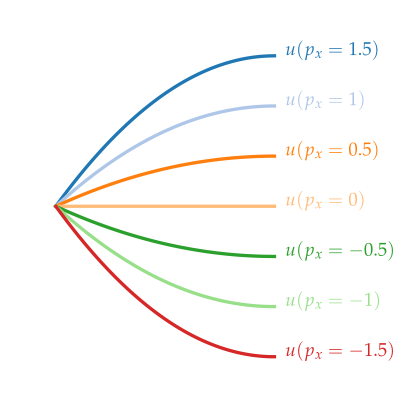
\[\begin{split}\begin{aligned} EA u &= - \frac{p\ti{x}}{2}x^2 + (p\ti{x} L + F) x + EAu_0 \\ u &= - \frac{p\ti{x}}{2EA}x^2 + \frac{p\ti{x} L + F}{EA}x + u_0 \\ u &= \frac{p\ti{x} L}{EA} \left( - \frac{1}{2L}x^2 + x \right) + \frac{F}{EA}x + u_0 \end{aligned}\end{split}\]

For \(p\ti{x}=0\) follows

\[\begin{aligned} u &= \frac{F}{EA} x + u_0 \end{aligned}\]

Parameter study of the bar deformation \(u\) on one side with known displacement \(u_0=0\) and on the other side with individual force \(F=0\) and \(p_x\). Note: \(L, E, A = 1\), quantities in SI base units
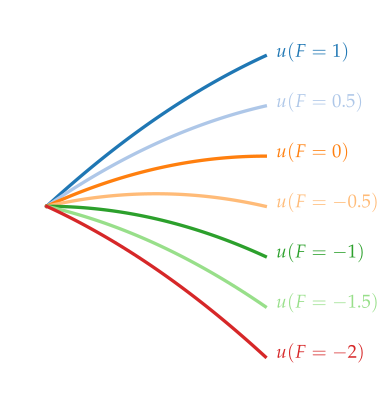
Parameter study of the bar deformation \(u\) on one side with known displacement \(u_0=0\) and on the other side with individual force \(F\) and \(p_x=1\). Note: \(L, E, A = 1\), quantities in SI base units

Or with opposing boundary conditions

\[\begin{split}\begin{aligned} EA \frac{\partial }{\partial x}u(x=0)=F~:& \qquad C_1 = F \\ u(x=L)=u_L~:& \qquad C_2 = EAu_L + \frac{p\ti{x}}{2}L^2 - FL \\ \end{aligned}\end{split}\]

follows

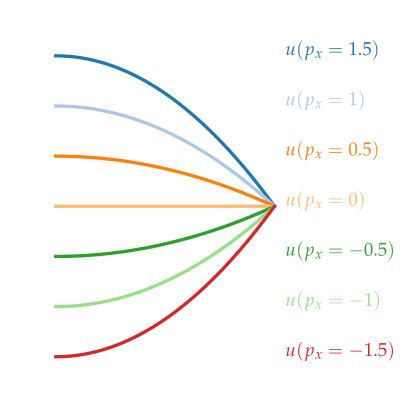
\[\begin{split}\begin{aligned} EA u &= - \frac{p\ti{x}}{2}x^2 + Fx + EAu_L + \frac{p\ti{x}}{2}L^2 - FL \\ u &= \frac{p\ti{x}}{2EA} \left( -x^2 + L^2 \right) + \frac{F}{EA}(x - L) + u_L \end{aligned}\end{split}\]

For \(p\ti{x}=0\) follows

\[\begin{aligned} u &= \frac{F}{EA}(x - L) + u_L \end{aligned}\]

Parameter study of the bar deformation \(u\) on one side with known displacement \(u_L=0\) and on the other side with individual force \(F=0\) and \(p_x\). Note: \(L, E, A = 1\), quantities in SI base units
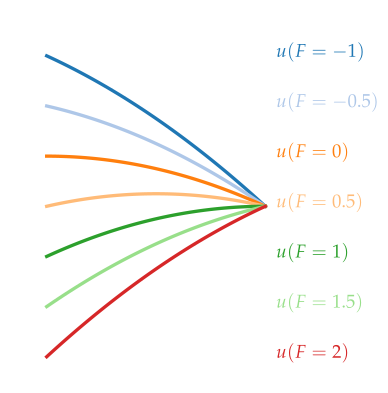
Parameter study of the bar deformation \(u\) on one side with known displacement \(u_L=0\) and on the other side with individual force \(F\) and \(p_x=1\). Note: \(L, E, A = 1\), quantities in SI base units

1.1.1.2 Variant on both sides with known displacement

With the corresponding boundary conditions

\[\begin{split}\begin{aligned} u(x=0)=u_0~:& \qquad C_2 = EAu_0 \\ u(x=L)=u_L~:& \qquad C_1 = \frac{EA}{L}u_L + \frac{p\ti{x}L}{2} - \frac{EA}{L}u_0 \\ \end{aligned}\end{split}\]

follows

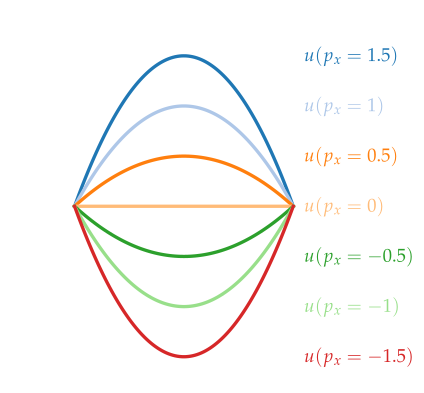
\[\begin{split}\begin{aligned} EA u &= - \frac{p\ti{x}}{2}x^2 + \left(EA\frac{u_L}{L} + \frac{p\ti{x} L}{2} - EA\frac{u_0}{L}\right) x + EAu_0 \\ u &= - \frac{p\ti{x}}{2EA}x^2 + \left(\frac{p\ti{x} L}{2EA} + \frac{u_L - u_0}{L}\right) x + u_0 \\ u &= \frac{p\ti{x} L}{2EA} \left( - \frac{1}{L}x^2 + x \right) + \frac{u_L - u_0}{L} x + u_0 \end{aligned}\end{split}\]

For \(p\ti{x}=0\) follows

\[\begin{aligned} u &= \frac{u_L - u_0}{L} x + u_0 \end{aligned}\]

Parameter study of the bar deformation \(u\) on both sides with known displacement \(u_0=0\) and \(u_L=0\) with distributed line force \(p_x\). Note: \(L, E, A = 1\), quantities in SI base units
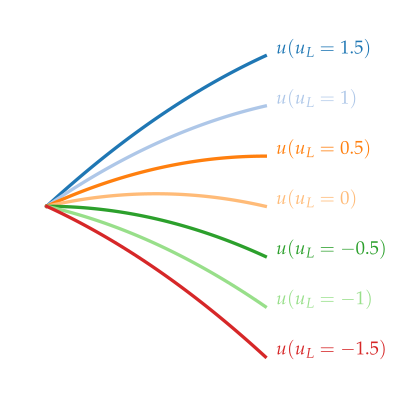
Parameter study of the bar deformation \(u\) on both sides with known displacement \(u_0=0\) and \(u_L\) with distributed line force \(p_x=1\). Note: \(L, E, A = 1\), quantities in SI base units